
ON FOLLOWING RECIPES
A low-stakes Christmas Day update that's all about following directions. Or not.

Dear Readers,
Merry Christmas! Or happy holidays, or a belated happy hanukkah, and so forth. I write these updates days or weeks in advance, and I thought about putting together something substantial for today, but then paused and thought: Christmas is not a major email day. Nor should it be. But I can’t stand to let a Monday slip by without reaching out to all of you with something cookery-related. I made a promise to do this weekly, and so I shall, even if the results will range from grand tours of complicated books to little essay-like updates like this one.
It occurs to me that I’m writing a weekly column about cookbooks without really explaining my own relationship with recipes. It’s sort of a critical piece of information, and what’s more, it’s something that’s interesting to think about whenever you bump into someone who is doing wonderful (or horrible) things in the kitchen.
My standing theory is that in every marriage, there is a cook and a baker. The cook goes on instinct, modifies freely, and “cooks from the heart.” The baker measures and tests, takes notes, leans on cookbooks and doesn’t have a romantic way to describe what he or she does. In my marriage, I’m the baker; my wife Becca is the cook, and while I think we’re both quite good at what we do, we certainly do it in different ways.
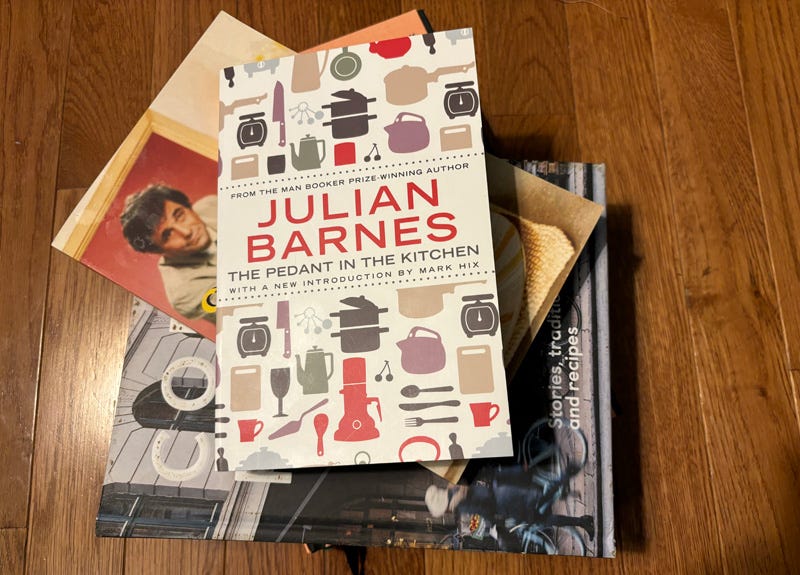
Julian Barnes, writing in his very enjoyable book The Pedant in the Kitchen sums it up as follows:
Pedantry and non-pedantry are indicators only of temperament, not of culinary skill. Non-pedants frequently misunderstand pedants and are inclined to adopt an air of superiority. ‘Oh, I don’t follow recipes,’ they will say, as if cooking from a text was like making love with a sex-manual open at your elbow. Or: ‘I read recipes, but only to get ideas.’ Well, fine, but let me ask you this: would you use a lawyer who said ‘Oh, I glance at a few statutes, but only to get ideas?’ One of the best cooks I know automatically gets down the recipe book whenever she roasts a chicken. The truth is, pedantry and non-pedantry can cut both ways. A pedant may vary from a dogged, uninquisitive, cloth-palated follower of orders to a devotee bent on doing everything absolutely right; while a non-pedant might be a simple lazy-bones or someone airy-fairily ‘creative’ in the worst, self-applauding way, or someone of justified confidence who has mastered technique and heard all the secret harmonies of the kitchen.
And that’s just it, isn’t it? As a diner and a guest, you don’t really care how much a chef has “used the force” and improvised versus doggedly executing every written step in a specific order; you care that you feel taken care of, and that whatever’s on your plate is delicious and prepared with love. You can get to that place as a cook on instinct, or you can get there by following a map. Most really good cooks use some of both methods, but not necessarily - I’ve met both purely instinctual and religiously faithful-to-the-text cooks who are terrific.
I learned to cook in my mid-20s, while working as a Middle East news editor and trying to escape the psychic damage of starting every day by talking about suicide bombings by making delicious food for my friends. My teacher was the Best Recipe cookbook by Cook’s Illustrated. The thing about this cookbook is that nearly every recipe is so lovingly detailed that you’re learning a technique as well as a dish. If you cook through it carefully and thoughtfully, you’ll end up knowing dozens of ways to prep, cook, and serve hundreds of different dishes, and you’ll be well on your way to cooking whatever from wherever you want in future years.
I cooked like an engineer, thinking about temperatures and thermal inertia and mise en place. I knew about the romance of the kitchen - my grandma Pat was a gifted and instinctive cook who create a meal more or less from memory - but that wasn’t my thing. I didn’t have a thing yet, in fact - I just knew that I wanted to have people over, and I wanted to feed them well, and I wanted to feel like a proper Grown Up. Mastering the kitchen was a critical step.
Hundreds of books and thousands of recipes later, I’m looser as a cook. I still tend to follow recipes carefully on the first pass, but I’ll regularly make adjustments after that - many of the recipes you’ll read in THE COOKBOOK TEST have been tweaked via my experience. (I try to always call out said tweaks so that the authors don’t take any blame for anything I’ve done to muck up their creations.) I’m at a point where if you thrust ingredients at me and insisted that I wing it, I generally could and would - but I’d still write a recipe first, so that I had a concept down on paper and could adjust and improve on the fly.
I like recipes that are thorough, and I’d rather be bored or overwhelmed by text than fall into the cracks of a sparse recipe that misses a critical technique or point of observation. This makes vintage recipes - with their sparse, cryptic evasiveness - challenging, and sometimes maddening. The best recipes are light on their feet, precise without being overly detailed or condescending, and reliable even when ingredients or cookware varies - as they inevitably do.
At any rate: here’s hoping your holiday season is a bright and lovely one, filled with the best food, the tastiest drink, and the most wonderful friends and family. Cheers, and I’ll see you in 2024.
At your service,
James